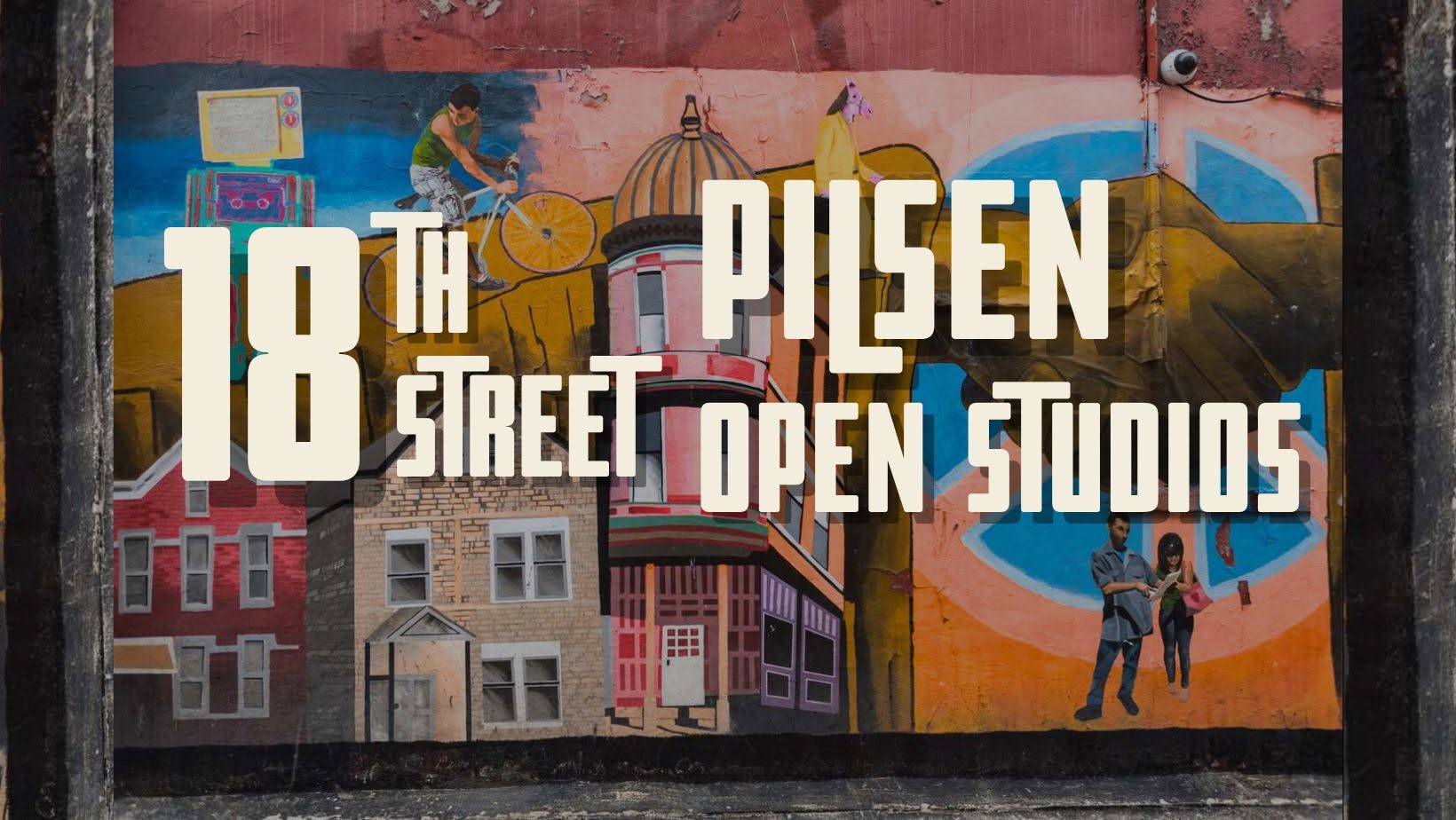
An arts district can be built two ways: by a landlord who buys the buildings and selects the tenants, or by the people already in them. Pilsen contains both experiments at once, four blocks apart, and 18th Street Pilsen Open Studios is the second one — organised through the Pilsen Arts and Community House rather than through a property portfolio.
One must occasionally notice who is holding the lease. It runs annually with programming through the year, and it reframes the format deliberately. A recent edition was staged not as an art walk but under a political banner, which is a decision no developer-run district would sign off on.
What Is In The Studios
Acrylic on panel. Spray enamel. Screen-printed cotton. Cut vinyl. Plaster.
The studios here are smaller and the work is more openly political than four blocks east, because the organising body is a community house and the selection pressure runs the other way. SZNL Chicago held an evening gathering in its industrial-style gallery in September that drew a crowd through the space without a single wall label, and the absence was not an oversight. Mana Contemporary occupies a converted industrial tower in the same neighbourhood with a view of the skyline from its upper floors, which is the other end of the same real-estate story.
The murals are the permanent collection and nobody curates them. A skull-headed figure on a brick side wall under blue sky does more for this neighbourhood's visual identity than any programme, and it was not commissioned by an institution.
The Clause Nobody Resolves
Pilsen's Mexican population has been declining for twenty years while its gallery count has risen, and the open studios are full of artists who are themselves part of the arithmetic that displaced the people who made the neighbourhood worth moving to. The community house exists because somebody noticed. It has not reversed anything.
Who Turns Up
They arrive on foot and in Spanish and English in roughly equal measure, which is not true of the district four blocks east. The behaviour is domestic rather than curatorial: people bring children, stay in one studio for an hour, eat, and leave without seeing most of the programme. Almost nobody is holding a map. Two visitors asked an artist where she lived before asking what she made.
This is not a smaller version of the arts district. It is the argument against it, operating in the same postcode.
Cover image: We Are A Nation Of Immigrants mural, Pilsen / Wikimedia Commons