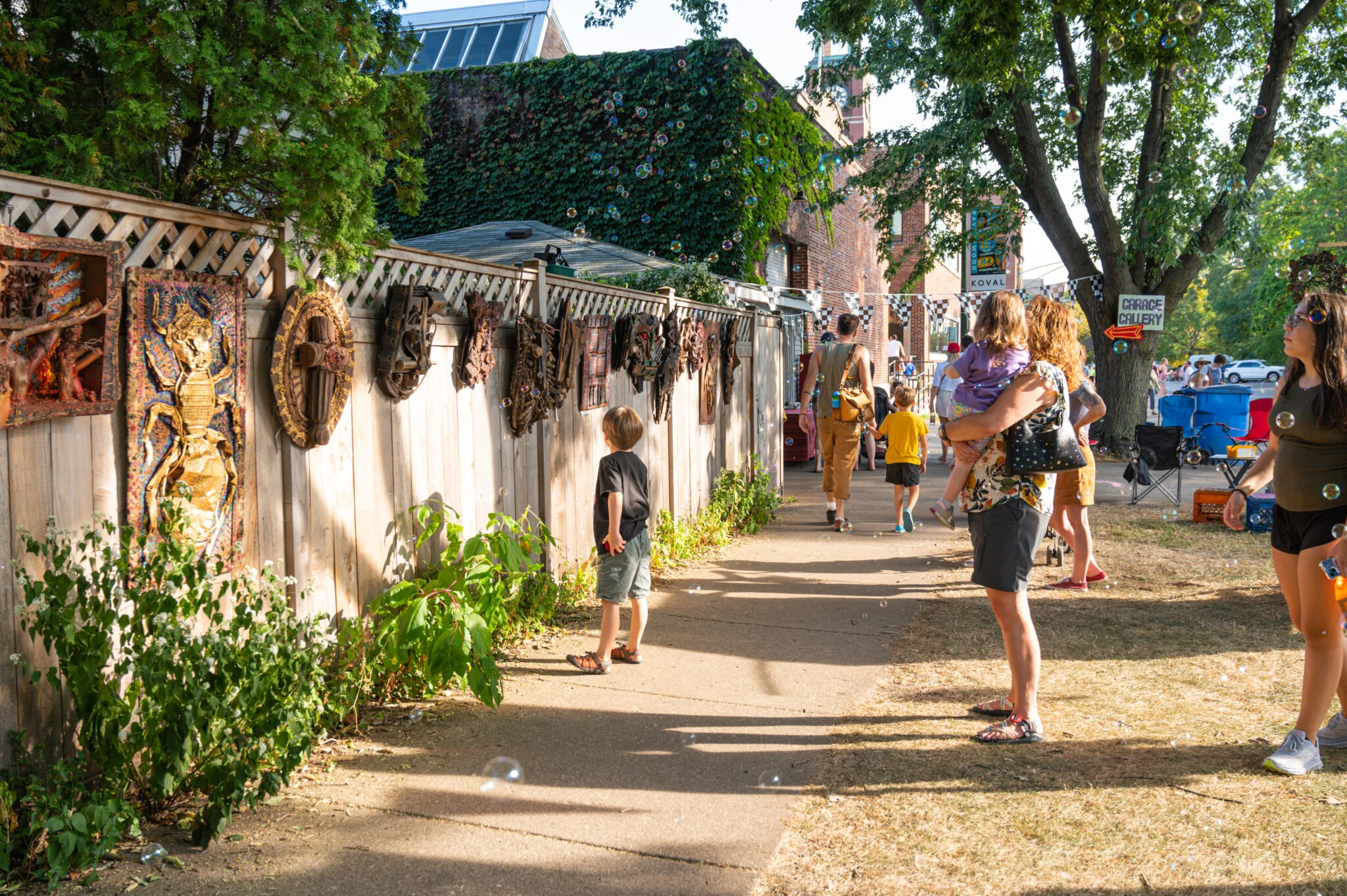
The Ravenswood Art Walk ran September 12 and 13 through the industrial corridor between Lawrence and Irving Park, more than fifty artists, free, with workshops and performances staged inside working buildings.
That last clause is the entire distinction. Every other art event of this Chicago summer erected tents on grass and asked artists to come out of their studios and stand next to their work in a nylon booth. This one did the opposite and sent visitors into the buildings where the work is actually produced.
A Studio Is Not a Booth
One cannot overstate how different those two experiences are. A booth presents finished objects arranged for sale, with everything that produced them removed. A studio presents the failures, the half-built things, the shelf of materials, the jigs, the wall where the artist pins what they are looking at. It is the difference between a conclusion and an argument.
It is also considerably less flattering, which is why fairs prefer tents. A studio visit exposes what a practice costs in square footage, rent, extraction fans and hours. Fifty artists agreeing to be seen at that level of detail, for free, over a weekend, is an unusual collective decision.
The Corridor Is Still Working
The setting is the second thing. This is an active industrial corridor — not a converted one, not a loft district with a heritage plaque. Manufacturing still happens on those blocks, and the artists occupy space inside that economy rather than on top of its ruins.
Chicago has run the other version of this story many times. Artists take cheap industrial space, the neighbourhood acquires a reputation, the rents follow, the artists leave, and what remains is a commercial strip with the word "arts" in its marketing. Wicker Park did it. West Loop did it faster. The craft market that now visits Division Street twice a year is the residue of that process.
Ravenswood has not finished the sequence. The dossier of this city’s summer records the corridor evolving toward tech and luxury lofts, and the art walk is being staged in the window before that completes. Which makes the 2026 edition worth documenting rather than merely attending, and makes the comparison with the Glenwood Avenue Arts District in Rogers Park instructive — that neighbourhood set out deliberately to retain its artists, and is the only part of Chicago that has demonstrably managed it.
The workshops are the part most visitors skip and the part that justifies the weekend. the published calendars carried the dates; the corridor is walkable end to end in an afternoon if one is disciplined about it.
Find the least presentable studio on the route — the one with the bad lighting and the unswept floor — and stay in it until the artist explains what the machine in the corner is for. Everything the tented fairs on the Grant Park lawns removed is in that room.
Cover image: vxla from Chicago, US / Wikimedia Commons (CC BY 2.0)