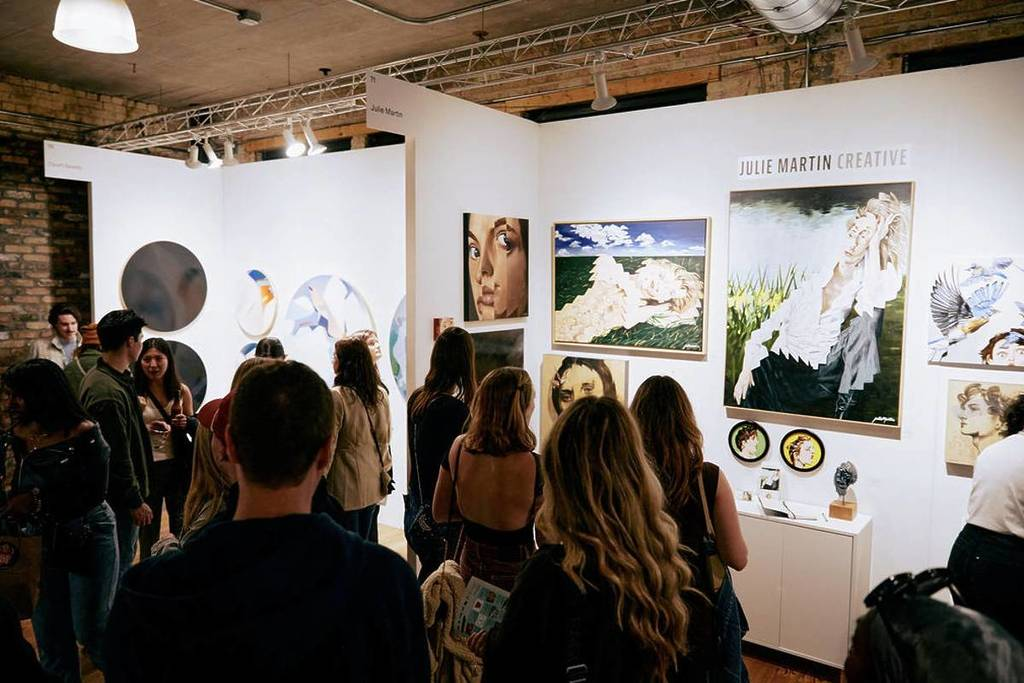
The gallery system is routinely described as a gatekeeper by people who have never had to price their own work, and the obvious test of that complaint is a fair with no galleries in it. The Other Art Fair, which ran April 9th through 12th at Artifact Events in Ravenswood, is that test: more than a hundred independent artists, selected by Saatchi Art, selling directly, seven miles from where EXPO was running the same weekend.
The result is not liberation. One cannot remove the dealer without handing the dealer’s job to the artist, which is a hundred people standing beside their own work for four days.
What Direct Sale Looks Like
Screen print on paper. Oil on board. Photographic prints, framed and unframed. Ceramic. Risograph.
Work ran from about five hundred dollars to five thousand six hundred and seventy, with the bulk clustered between two and three thousand — a band that does not exist at EXPO, where the floor is roughly where this fair's ceiling sits. One table held three screen prints on a green cutting mat, a line-art figure in bed with a cat and a small feathered dinosaur among them, priced for somebody's first purchase.
The architect and urban sketcher David Roberts came on opening night to see the photographer Morgan Anderson's work and spent the evening making quick drawings on site, which is the most interesting thing anyone did at any Chicago fair in April: a visitor producing work in response, in the room, for nobody.
Artifact Events is a former factory on the Ravenswood rail corridor, which is why the fair fits — the ceiling height absorbs a hundred booths without the grid feeling like a grid, and the industrial light is closer to studio light than Festival Hall's ever gets.
The Transaction Is The Subject
Visitors talked to the artists, which sounds unremarkable and is in fact the entire structural difference. At a gallery booth the conversation is with staff and the artist is absent and often dead. Here the maker is two feet away, and the behaviour that produced was constant, slightly strained small talk — people complimenting work they had no intention of buying, artists thanking them, both parties aware of the arithmetic. The booths where nobody was talking were the ones doing business.
Cutting out the dealer does not democratise the market. It makes every artist their own dealer, which is a heavier job than the complaint admits.
Cover image: Ravenswood Avenue rail corridor / Wikimedia Commons