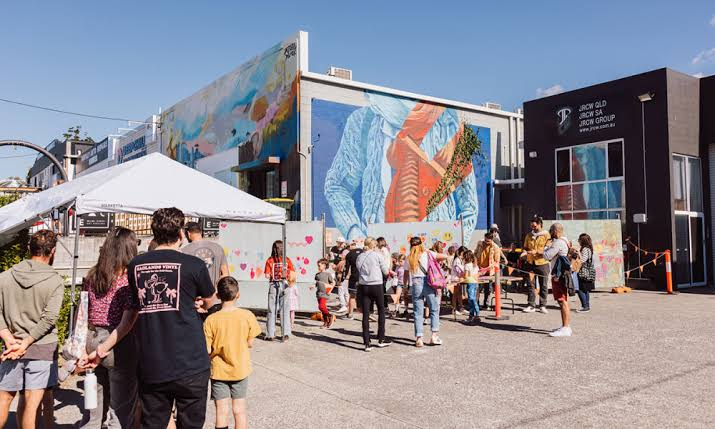
The Gold Coast Art Fair set up more than 200 artists on Butler Field over June 20 and 21, its sixty-eighth year, admission $12.51. Neither the Gold Coast nor a gold coast is anywhere in sight. The fair long ago left the neighbourhood that named it and now occupies a rectangle of Grant Park lawn, which is a fact about American art fairs rather than a criticism of this one.
The Price Has a Decimal in It
Begin with that $12.51, because the two pennies are the most revealing detail of the weekend. A fair does not price a ticket at $12.51 by deliberation. It prices it at twelve dollars and then a platform adds its fee, and the number the public sees is the arithmetic of the intermediary rather than a judgement about the worth of the thing.
One sees the same fingerprint across the season — the $12.79 Panda Fest door, the $18.18 Puerto Rican Fest ticket, the $373.05 Michelada top tier. Chicago’s summer is now priced to the cent by ticketing software, and the fairs have stopped noticing that this is a strange way to announce the cost of looking at paintings.
Sixty-Eight Years Without a Neighbourhood
The deeper question is what a fair is once it has been separated from the place it came from. Sixty-eight years is a serious run, and the fair has genuine standing with the artists who exhibit in it. But a lawn in Grant Park is not a context. It is a surface.
Set it against the 57th Street Art Fair, which has spent seventy-nine years on the same two Hyde Park blocks and never left, or the Old Town Art Fair, which is inseparable from the landmark district it runs through. Those fairs are about somewhere. This one is about a weekend.
The artists, it should be said, are not the problem. Two hundred exhibitors of this calibre would repay attention anywhere, and the jurying is not lax. What the setting removes is the reason to be in that specific spot, and once that is gone a fair competes purely on convenience — which downtown parkland wins easily, and which is exactly why the fair moved.
Butler Field had a busy 2026. It also held El Grito in September, to visibly thin crowds under rather different pressures. A lawn that can host both an art fair and a civic ceremony in one summer is useful municipal infrastructure and belongs to neither.
Ignore the perimeter, where the reproductions and the sponsor tents live. Walk to the back rows, where the artists who could not afford a corner booth are, and stay in one of those tents until the person inside stops giving you the sales version. The fair’s actual jury results are back there.
Cover image: Via NBC Chicago