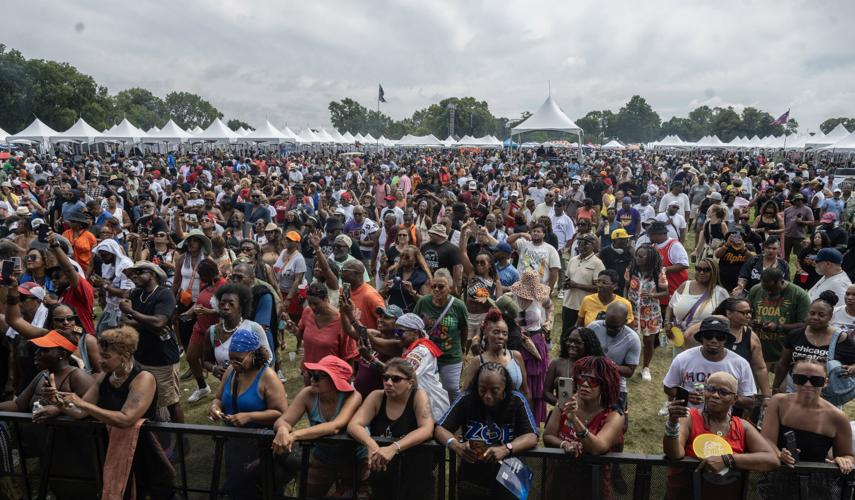
By eleven in the morning the grass in Jackson Park was already handing the heat back, and the people who understand how this day works had claimed their shade an hour before that. Folding chairs in closed rings. Coolers with the lids propped open. Aluminum trays going out under white canopy tents, a woman in a battery-powered neck fan moving down the row with a plate in each hand. The banner over the main stage read 36 Years of House and carried eight names beneath it: Wayne Williams, Jesse Saunders, Tony Hatchett, Alan King, Andre Hatchett, Terry Hunter, Mike Dunn, Kim Parham.
Saunders is the man generally credited with pressing the first house record. Williams has been running the Chosen Few since 1977, and the picnic has happened every July since 1990, when it was a couple hundred people in a backyard behind the Museum of Science and Industry and nobody was calling it the Woodstock of anything. Nobody on the grass on July 11th needed that recap. General admission ran $89.94, which buys you a field, a sound system and the reasonable expectation that someone you have not seen since the pandemic will find you by three.
The Widening
What changed this year was who got a slot. Alan King, who programs the day, opened the bill toward ghetto house and juke — the faster, harder, cheaper-sounding strains that came out of the same South Side bedrooms as everything else on that banner and have spent thirty years being treated as house music's embarrassing younger cousin. King's stated reasoning was about being more inclusive of the whole house crowd and keeping the focus local. In practice it meant DJ Slugo got a daytime slot at the most establishment event in Chicago house.
He did not ease into it. "Get Down Lil Mama" came in at a tempo the lawn chairs were not engineered for, and you could watch the field sort itself in real time — people who knew every word moving toward the barricade, people who did not staying exactly where their coolers were. "There's Some Hoes in This House" is thirty years old and still sounds like it was recorded in a basement on purpose, all treble and nerve. "Let's Go to The Mo" landed as pure neighborhood shorthand. By "Let's Juke" the footwork had started, which at a picnic means a ring opens up on the grass and does not close again for twenty minutes. Boolu Master followed in the same register. The ring held.
Earth Song, and Somebody's Son
Terry Hunter has the hardest job on that stage, which is to follow the history lesson with something that works as a party. He did it by mixing Michael Jackson's "Earth Song" into a house arrangement — a maximalist, faintly ridiculous choice that a lesser DJ would have played for irony and that Hunter played completely straight. It is a record about ecological grief. On a Saturday in Jackson Park it functioned as a singalong. I do not have a theory for why that worked.
Earlier in the day Hunter had stood off to the side of the booth while his son, DJ Tai, played — the youngest DJ ever to get a set at the picnic. That is the whole argument of this event compressed into one sightline: a man who has been on the banner for years, watching from the wings, while the thing he helped build hands itself forward. Kym Mazelle, who was the First Lady of House in this city in the mid-eighties before Europe took her, was somewhere in the crowd for her second picnic. DJ Jazzy Jeff was there too, posing for selfies near the stage like a man on holiday.
What the Park Is
Jackson Park is Frederick Law Olmsted's, laid out as the southern anchor of a system he designed with Calvert Vaux, and it held the World's Columbian Exposition in 1893 — the White City, the fair that gave Chicago its civic self-image and a permanent habit of overbuilding for visitors. The Museum of Science and Industry is the one building left standing from it, which makes the backyard where this picnic started a kind of footnote to a footnote. At the north end the Obama Presidential Center is going up. Whatever that does to this neighborhood, it will do it to the ground this festival stands on.
Which is the case for holding it here rather than in Grant Park, where the city puts the things it wants photographed. Open field, no roof, sound that has to fight the lake air and mostly wins because the system is overspecified for the job. I counted three separate crews in matching shirts within fifty feet of one tent — SMOK'N FEW in cigar-logo grey, JACK MY BODY in a graphic print, the Chi Town Smoke Kings under their own canopy. That is not a crowd. That is a set of standing appointments that happen to coincide.
The sponsor step-and-repeat carried UNCF, V103, the Illinois Lottery and Blue Cross Blue Shield, which tells you this is now an institution with a budget, produced by Special Events Management and insured accordingly. Fine. The programming is still being decided by people who were in the room when the genre started, and this year they used that authority to let the rude cousin in.
Walking back toward Stony Island at seven, past the last tents being folded and a man asleep upright in a camp chair, I heard a woman behind me tell her friend the picnic owed her nothing. She meant it as the highest possible compliment. Thirty-six years in, the Chosen Few are running the only festival in Chicago where the lineup is an argument about lineage and the audience is qualified to judge it.
Cover image: Jackson Park, Chicago / Wikimedia Commons