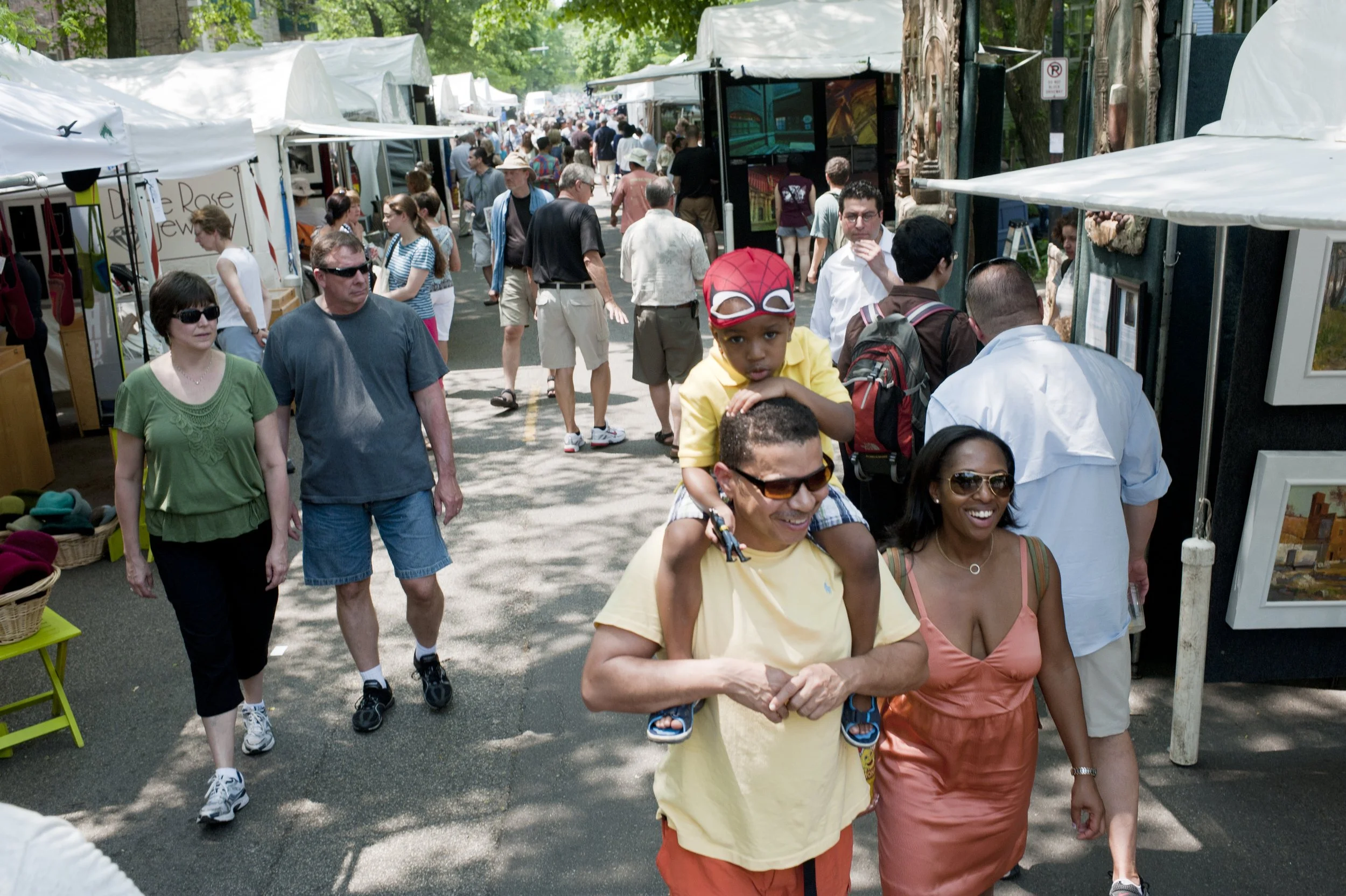
One must occasionally be reminded that the oldest thing is not always the grandest thing. The 57th Street Art Fair returned to the two blocks between Kenwood and Woodlawn on June 6 and 7 for its seventy-ninth year, which makes it the oldest juried art fair in Chicago and older than most in the country, and it remains free to walk into.
Founded in 1948 by Hyde Park neighbours, it predates the entire American art-fair apparatus that now surrounds it — the wristbands, the sponsor arches, the suggested donation collected by a volunteer with a tablet. Seventy-nine years of jurying, on a residential street, without arriving at a gate fee.
The Jury Is the Point
Juried is the operative word and it deserves defending. An open-entry fair is a marketplace. A juried fair is an argument: somebody has looked at the submissions and decided which ones belong, and is prepared to be wrong in public. That is the same discipline that separates a real exhibition from a trade show, and a neighbourhood fair that has maintained it for seventy-nine consecutive years has done something no commercial operation in this city can claim.
The artist count for 2026 is genuinely unsettled, which is worth stating rather than papering over: the published calendars put it at close to 200, while the published calendars reported 150 or more. Somewhere between those two numbers is the truth, and the fair has never been the sort of organisation that issues a corrective press release.
What Hyde Park Gets Right
The setting does work that a park cannot. A fair on 57th Street sits among houses, the University of Chicago a few blocks off, bookshops within walking distance, and people who live there passing through on the way to something else. Compare that to the tented fairs erected on Grant Park lawns each June, where the art is surrounded by nothing and the visitor arrives specifically to shop.
One cannot walk these two blocks without noticing that the fair’s longevity and its refusal to charge are the same fact. It never became a revenue instrument, so it never acquired the pressures that force a fair to widen its jury until the jury stops meaning anything. Seventy-nine years of turning people down is why it still has standing.
Hyde Park has a habit of this. The Hyde Park Jazz Festival reached its twentieth year in September on the same principle — free, artist-first, volunteer-heavy, and considerably more serious than its budget suggests. Two of the most rigorous cultural institutions in Chicago sit within a mile of each other on the South Side and neither charges admission.
If the aisles become crowded by late Saturday afternoon, as they do, the correct response is to leave and walk two blocks east toward the lake, then come back at nine on Sunday morning when the artists are still setting up and will talk to you about the work rather than the price. That hour is the fair. The rest is the crowd.
Cover image: Warren LeMay from Chicago, IL, United States / Wikimedia Commons (CC BY-SA 2.0)