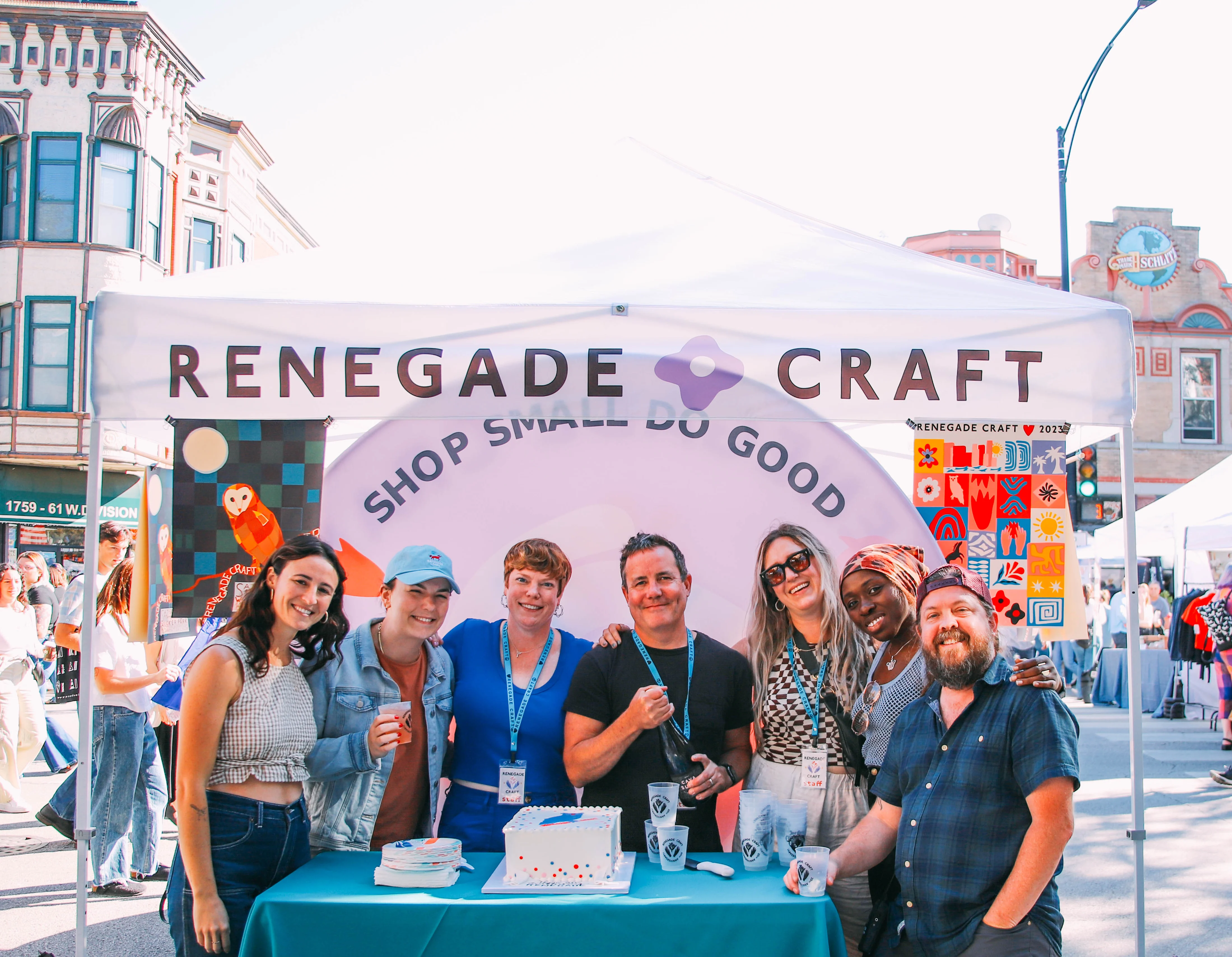
The craft fair is the one art event where nobody pretends to be looking. At a gallery the visitor performs attention; at a fair on a closed street the visitor shops, and the shopping is undisguised. For twenty-three years this has looked like the form's disqualifying weakness. Standing on Division Street on the weekend of September 12th and 13th, between Damen and Ashland, among white tents running four blocks deep, I am prepared to concede that the honesty is the point. One cannot evaluate a fair without first accepting that it is a market, and this one does not insult you by claiming otherwise.
Renegade Craft began in Chicago in 2003 and now calls this city the heart of its community, which is marketing but is also true — the organisation ran three editions here in 2026 alone. The spring market on May 16th and 17th carried more than 250 artists. In July it took Kedzie Boulevard in Logan Square between Fullerton and Palmer Square, eleven to six. By September it was in Wicker Park. Entry is a five-dollar suggestion collected by scanning a code, which is to say entry is free and politely framed.
The Jury Is a Fee
There is no curator to credit here, and that absence is the subject. A juried show publishes its numbers: submissions received, works selected, the panel's names and institutions. Renegade publishes a booth fee. The selection mechanism is a thirty-dollar application and the capacity to front seven hundred and fifty dollars for two days of street.
We know those figures precisely because Liz Marie Mortensen, who works as Laila Textiles, filmed herself sitting in her studio and reading out the arithmetic after the Logan Square edition. Seven hundred and fifty for the booth. Thirty to apply. Two hundred and thirty-five to hire help across Saturday and Sunday. Fifty for food while working. One thousand and sixty-five dollars in baseline expenses, before her own labour, before materials, before tax. She owned her displays already and noted that a vendor who did not would add five hundred to a thousand more. Against that she processed two hundred and eleven transactions at an average order of fifty-one dollars and twelve cents.
Laila Textiles reads out the cost of a two-day booth
From the postSPILLING THE TEA 🫖 ON HOW MUCH $$ I MADE @renegadecraft Chicago Logan Square! Thank you to everyone who stopped by my booth 💗 it was such a fun time!
3,874 likes · View all 154 comments
That video is the most useful piece of criticism the fair produced this year, and no institution commissioned it. It establishes the real entry requirement, which is not talent but working capital. Sam of Stokes Jones Studio drove more than seven hundred miles from South Carolina with her husband Fuller doing the unloading and the parking so that she could build the tent — wooden shelves, mugs, bowls, a sign reading MAGNET TRIO $20. Setup weather was rain. It cleared. One does not make that drive on speculation; one makes it because the Chicago market reliably returns the fuel.
What Is Actually On The Tables
Glazed stoneware. Felt. Glass bead strands by the hundred. Quilted cotton. Vintage denim in sizes to 4X. Screen-printed paper. Enamel pins.
The inventory is more interesting than its reputation. Christina Covington paints animals and florals onto mugs and plates. Jenna Bean fills a tent with several hundred small ceramic figures sorted strictly by colour — tomatoes into citrus into lemons into frogs — an arrangement with more curatorial discipline than several West Loop galleries manage. Rabbit Foot Studios hangs quilts as wall work, which is the correct claim. Kari Lee makes a framed felt rendering of Cheez-Its and a plush baguette with an angry face, and I walked past these twice before going back, which is a verdict one does not plan to deliver. Lost Girls Vintage, a woman- and immigrant-owned shop on this street since 2013 with Dolly Parton painted in the window, wheeled its own racks out of its own doorway.
Several hundred ceramic figures, sorted by colour
From the postAfter 5 years of going to markets and 1.5 years of being a full time ceramic artist- this past 6 weeks has been the busiest and CRAZIEST of my whole entire life!!!!! AHHHHH I LOVE YOU ALL AND MY LIFE THIS IS SO CRAZY…
9,763 likes · View all 136 comments
The best object at the fair cost four quarters. Hadley operates a red coin-fed vending machine that dispenses one of eight Chicago prints at random for a dollar. A machine that refuses to let you choose is doing something no booth of carefully arranged prints can do, which is to remove taste from the transaction entirely. The wall text, one notes, is a coin slot. It has declined to explain itself.
The Thing The Fair Is Inside
Division Street between Damen and Ashland is not neutral ground for a conversation about what artists can afford. This is the stretch that priced out the painters who made it desirable, in the neighbourhood whose arts-building silhouette still anchors the skyline at Milwaukee and North, and the fair that fills it for a weekend charges a maker a thousand dollars to stand on it. Renegade did not cause that and cannot fix it. It is simply the economics, briefly made visible, on the exact pavement where the question is live.
So the reversal, and it is not the expected one. These are not hobbyists selling trinkets under a tent. They are small manufacturers running two-day retail activations at a cost structure that would make a gallerist flinch, and the ones who return every year have solved a problem of logistics and pricing that most exhibiting artists never have to think about. The rigor is in the spreadsheet.
A walk down the September market
By the third block the tents blur into one long table of pleasant objects, and the shoppers stop reading signage entirely — they scan a booth, decide in under two seconds, and move. The exception was Hadley's vending machine, where people queued four deep for a dollar print they could not choose, and stood looking at whatever it gave them for far longer than they had looked at anything they selected themselves.
This is not a market pretending to be an exhibition. It is a manufacturing sector that has learned to retail itself two days at a time.
Cover image: Renegade Craft fair https://www.renegadecraft.com/