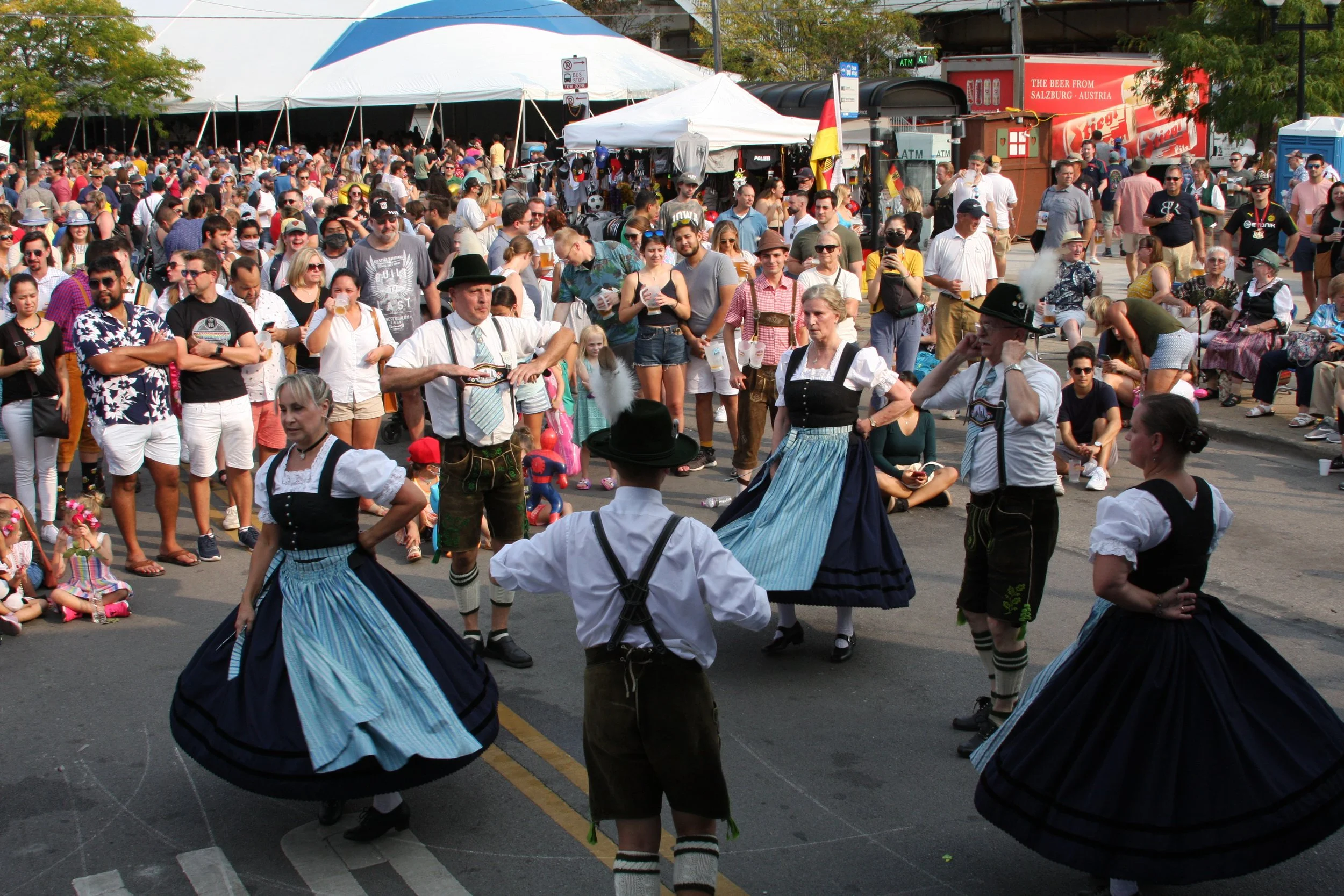
Maifest took Lincoln and Western over the end of May, free, a German cultural celebration with beer in the historically German neighbourhood of Lincoln Square.
The dates are genuinely unresolved, which is worth stating rather than smoothing over. the published calendars has it as May 29 to 31. the published calendars has it running May 29 to June 1. Both are reputable and they do not agree, and the festival’s own publicity did not settle it.
Three German Events, One Neighbourhood
Maifest is not the only one. Lincoln Square also produced the Chicago German-American Oktoberfest in September — dates for which also conflict, one listing saying September 11 to 13 and another September 5 to 7, to the point where there may simply be two different Oktoberfests — and the Von Steuben German Day Parade on September 12, running up Lincoln Avenue from Irving Park to Lawrence.
Three German-identified public events in one neighbourhood in one year. That is a substantial commitment to an identity, and it raises the question of what is being sustained.
Branding or Community
Lincoln Square’s German character is now largely commercial. A handful of businesses carry it genuinely — the delicatessens, a couple of the restaurants, the shops that have been there for decades — and they are real. The residential population is not meaningfully German in the way it was mid-century, and the streetscape’s Germanness is partly a design decision maintained by a chamber of commerce.
The same question applies a few miles east in Andersonville, where a Swedish midsummer festival turned sixty this June on a strip that is now one of Chicago’s queerest and most Middle Eastern. Both neighbourhoods perform an ethnic identity that has largely moved out, and both do it well enough that nobody complains.
There is a generous reading and it is probably the right one. A heritage festival that outlives its original community becomes something else — a neighbourhood tradition rather than an ethnic one — and the people running it are usually the descendants of the institutions rather than opportunists. Beer, a brass band and a closed street in May does not require anybody present to be German.
The less generous reading is that "historically German" is doing commercial work on behalf of property values, and that a free festival is a cheap way to maintain a brand.
Both things are true at once, which is how neighbourhood identity generally works in this city. What is not defensible is that nobody can say for certain which weekend the festival happened on.
Cover image: Erstwhile.Human from Ellensburg, Washington, USA / Wikimedia Commons (CC BY-SA 2.0)