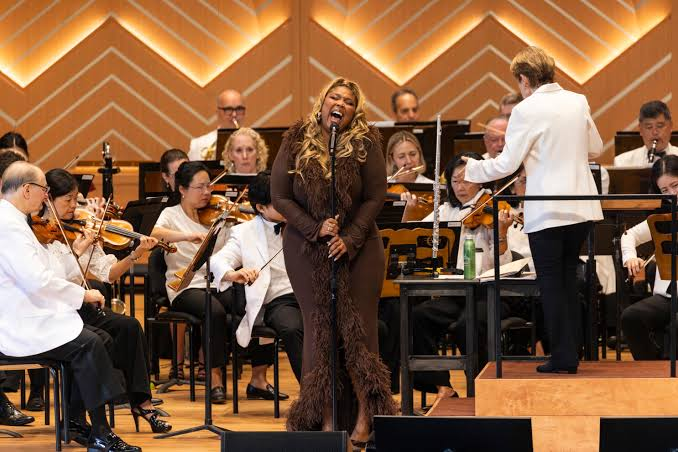
The air inside a new concert hall on its first public night is dry and slightly too cool, because the climate system has been running for days against an empty room. Lizzo walked onto the reopened Hunter Pavilion stage at Ravinia on July 11th carrying a flute, and did not sing.
She trained on that instrument before she was a pop star and has spent a decade being treated as though the training were a novelty. Nobody in the pavilion needed that explained once she started playing.
The renovation cost $70 million. Two independent newsroom accounts put the figure at seventy, which settles a number that had been reported variously as seventy and seventy-five across the summer. Pavilion seats ran around $70 for the gala. The lawn, as always, was cheaper and fuller.
The Orchestra Was The Headliner
This was the Chicago Symphony Orchestra's opening night of its ninetieth residency season at Ravinia, conducted by chief conductor Marin Alsop, with the pianist Yunchan Lim playing Ravel's Piano Concerto in G. Lim is the reason the musicians were watching the stage rather than their stands. Ravel's concerto has a slow movement built on a single long melodic line over almost nothing, and in a hall whose entire sales pitch is definition, it functioned as the actual test. The hall passed.
Lizzo's contribution sat inside that programme rather than beside it, and she spoke briefly about what music had done in her own life before playing. The audience applauded the speaking more than the playing, which tells you who they thought they had come to see.
The night carried three anniversaries at once, which is how an institution justifies a capital campaign: the sixtieth gala evening, the orchestra's ninetieth season in residence, and the first public use of the rebuilt hall. Stacking them means no single one has to carry the ticket price.
What Seventy Million Bought
Sharper definition, which is the claim, and it is audible — the string sound arrives with edges on it in a way the old pavilion never managed. What it did not buy is any change to the lawn, where most of Ravinia's audience sits and where the experience remains a competent reinforcement of a concert happening elsewhere.
That split is the whole economics of this venue. A seventy-million-dollar hall seats a few thousand. The lawn holds the rest, for a fraction of the price, and hears a different show.
Four women on the grass near me had brought folding chairs, a cooler and a cheese board, and stayed through the Ravel. A pop star opened a classical hall by shutting up.
Cover image: Ravinia Festival grand entrance / Wikimedia Commons