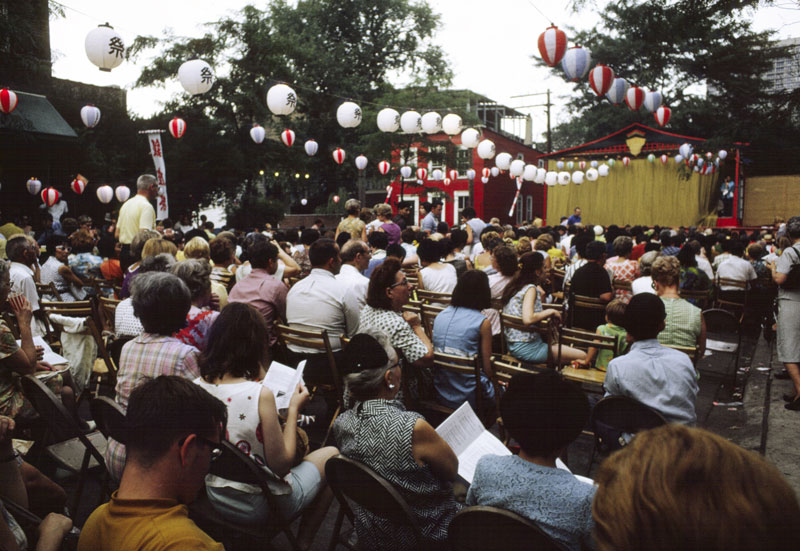
The Ginza Holiday Festival ran August 7 to 9 at the Midwest Buddhist Temple in Old Town: taiko, demonstrations of classical Japanese arts, and food. On the surface it is one of the more charming small festivals of the Chicago summer. Underneath it is one of the least understood.
The Midwest Buddhist Temple was founded by Japanese Americans who came to Chicago after being incarcerated by their own government during the Second World War. Resettlement brought a Japanese American community to this city that had not previously existed at that scale, and the temple was built by people who had been released from camps and directed away from the West Coast.
A festival with that immediately beneath it is not a heritage pageant. It is an institution founded in the aftermath of mass detention, still operating, still holding a public weekend at which it demonstrates its own cultural forms to strangers.
Why the Arts Demonstrations Are the Substance
This is where the programming choice becomes an argument. The festival could present Japanese culture as spectacle, and taiko in particular rewards that treatment — it is loud, physical and photographs well. Instead the weekend is built around demonstrations of classical arts, which is to say around technique shown slowly enough to be understood.
One cannot watch a demonstration of that kind without registering what it is for. A community that was scattered by policy and reassembled in an unfamiliar city preserved a body of practical knowledge, and the way such knowledge survives is by being performed in front of people who do not yet have it. The demonstrations are not an educational supplement to the festival. They are the mechanism by which the thing continues to exist.
Taiko in Old Town is also, straightforwardly, worth hearing. But the drums are the part that draws the crowd, and the quieter tables are the part that explains why there is a temple there at all.
The Least-Covered Strong Story of the Summer
Old Town spent the same summer hosting the Old Town Art Fair and the Wells Street Art Festival on one June weekend, between them drawing more than 300 exhibitors and a great deal of press. Ginza Holiday received a line in the Choose Chicago guide and a mention in the published calendars.
That ratio is the story. A neighbourhood produces two large commercial art fairs and one festival run by a religious institution founded by formerly incarcerated citizens, and the coverage divides accordingly. It is a reasonable illustration of what the Chicago summer calendar notices.
Arrive before the taiko and go to the demonstration tables while they are still quiet. Choose one art — whichever you understand least — and remain at that table until the person working has shown you the stage of it that goes wrong. Everything the festival is protecting is contained in that correction.
Cover image: Alberto Aldana / Wikimedia Commons (CC BY-SA 2.5)