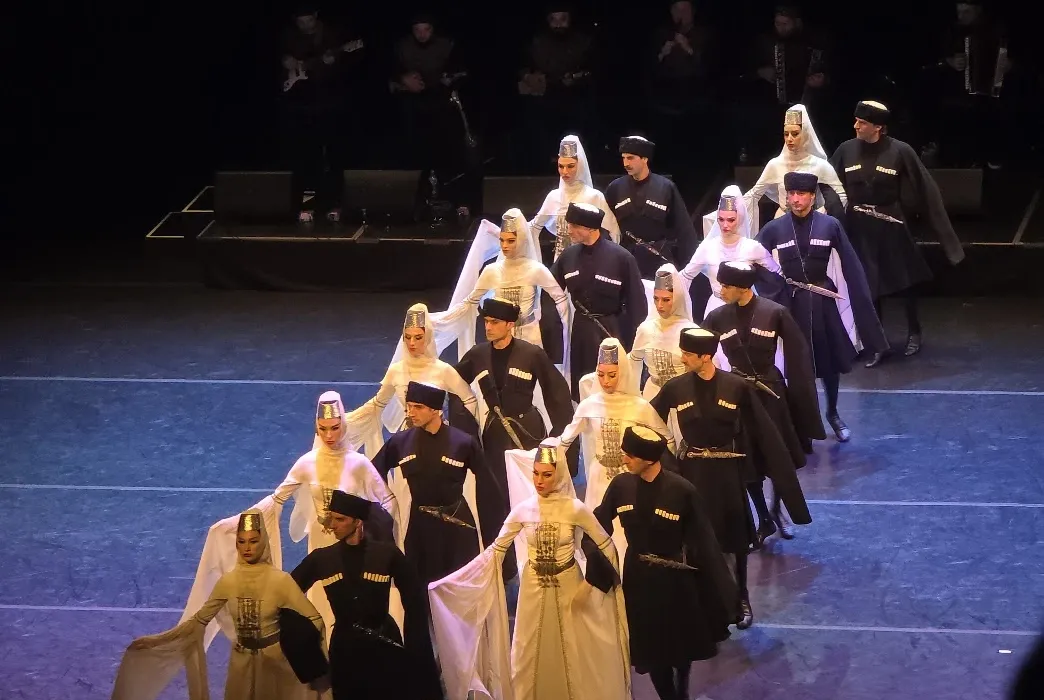
The Harris runs cold and the stage was hazed to the point where you could see the light in the air, and the first thing that happened was a drum. Not an entrance, not a downbeat from a conductor — a drum, from a platform upstage where ten or so musicians sat in the dark for the whole evening. Sukhishvili, the Georgian National Ballet, played one night at the Harris Theater on Tuesday October 20th at eight, on the American leg of a tour marking the company’s eightieth year.
What arrived is not a story ballet and does not want to be. It is a run of regional dances, billed as the most emblematic of the past eighty years, and the evening is structured as a gauntlet rather than as an arc. The company was founded in 1945 by Iliko Sukhishvili and Nino Ramishvili and is run now by their grandchildren, Iliko Sukhishvili Jr. as artistic director and chief choreographer and Nino Sukhishvili as general director and costume designer. Nobody in that house needed the lineage explained.
What It Costs
Here is the thing worth understanding before anything else. The men dance on the points of their toes in soft leather boots, with no block and no shank in them, and they land jumps on the tops of their feet. In the finale they go down and spin across the full width of the stage on their knees. There is no trick to it and no padding that would survive a costume fitting. Everything in this show that looks effortless is a technique that is specifically destructive, performed by people who have decided to pay for it.
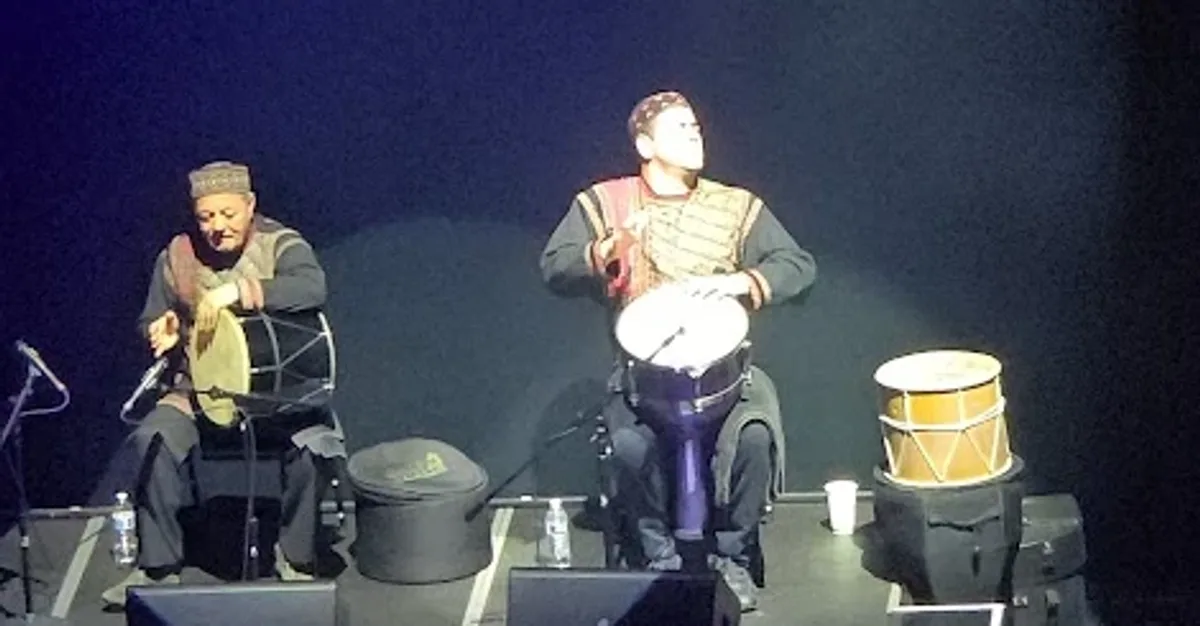
The orchestra is the reason the evening works, and it is the part a Chicago audience is least prepared for. Accordion, duduk, stringed instruments, and drums that do not function as accompaniment so much as architecture. Khorumi, the men’s war dance, is built over a drumline that keeps accelerating under a five-beat count while the dancers drop to the floor as though crawling under fire and then vault onto each other’s shoulders. Somewhere in the second half the stage went to two drummers and nothing else. They sat forward on the platform with the drum across one knee, traded a figure back and forth, and kept doubling it until the hands stopped reading as separate strikes. Nobody was dancing. Nobody needed to be. The company publishes no roster and credits no individual musician anywhere — not on its own site, not by the theatre — so I cannot give you either name, which is a discourtesy to the best ninety seconds of the night.
Three Women, One Queen
Samaia is three women in gold crowns and it is the quietest thing in the programme. They enter pressed so closely together that they read as one figure with six arms, which is the point: the dance comes off a twelfth-century image of King Tamar, and the three of them are one monarch until they separate. The arms move at a speed that has nothing to do with the feet. Almost no one in the room was breathing.
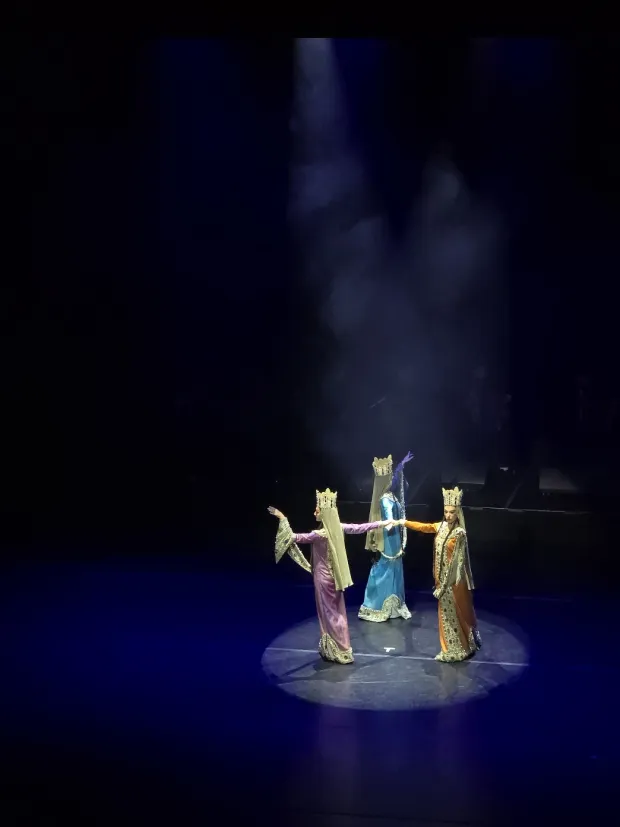 Samaia, entering as one figure
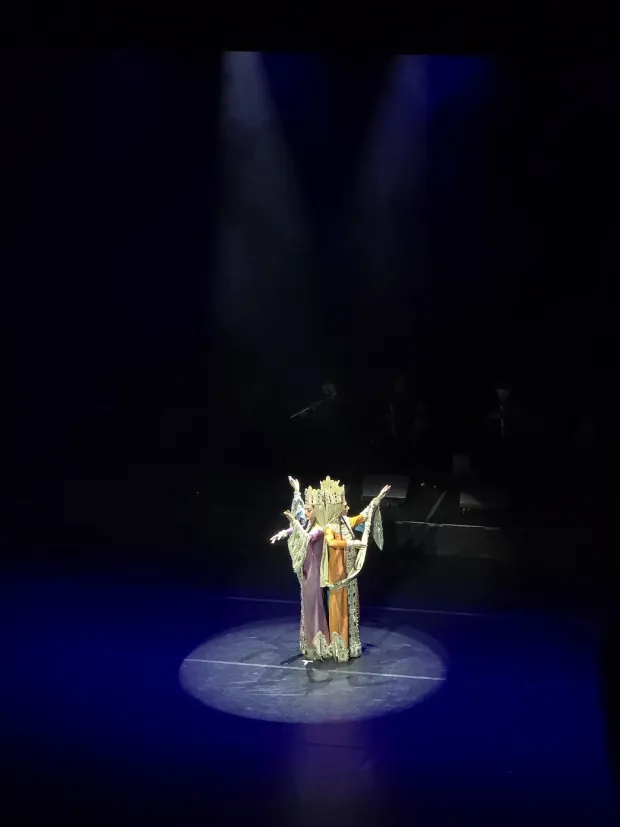 Pressed into a single column
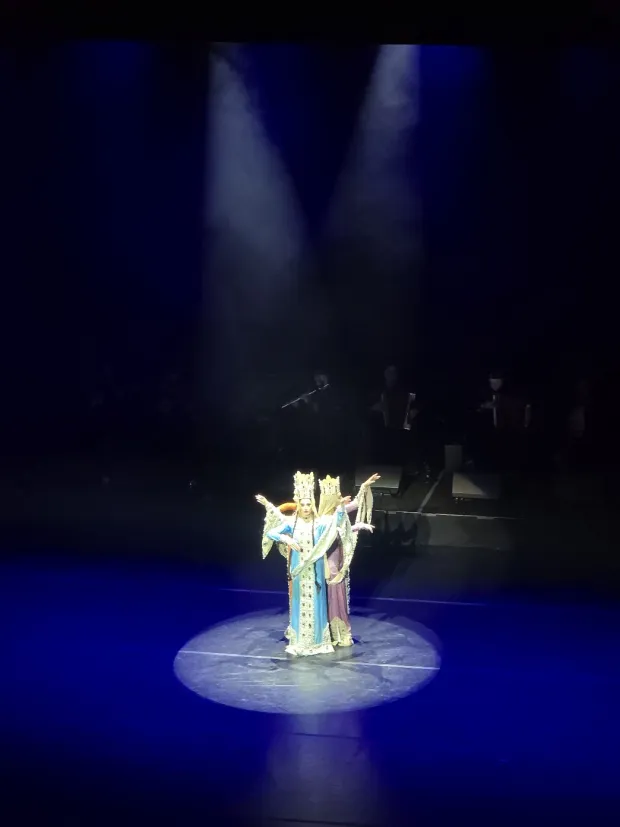 Six arms, one monarch
Against that, Kintouri is a joke and knows it. The kintos were Tbilisi street traders who carried their stock on their heads, and the dance keeps both the balancing and the swagger: a silk shawl pulled off a silver belt, a full wine bottle balanced upright on top of his head with both hands nowhere near it, and a man moving as though the hardest part of his day is other people. It got the first real laugh of the night.
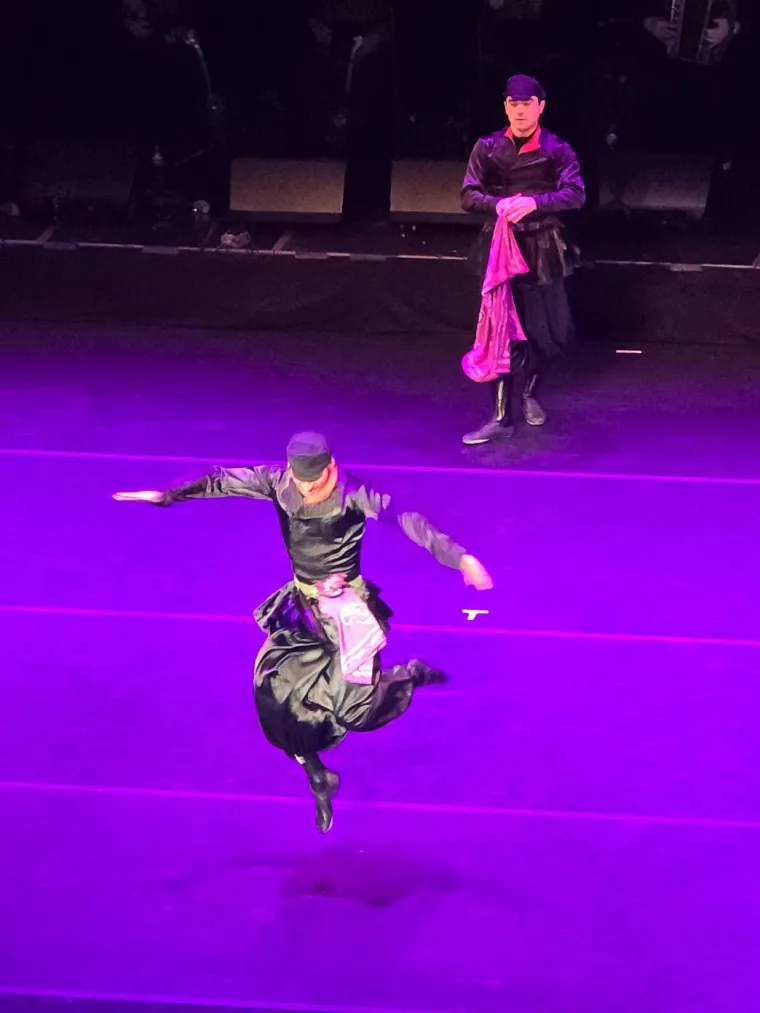 The shawl off the belt
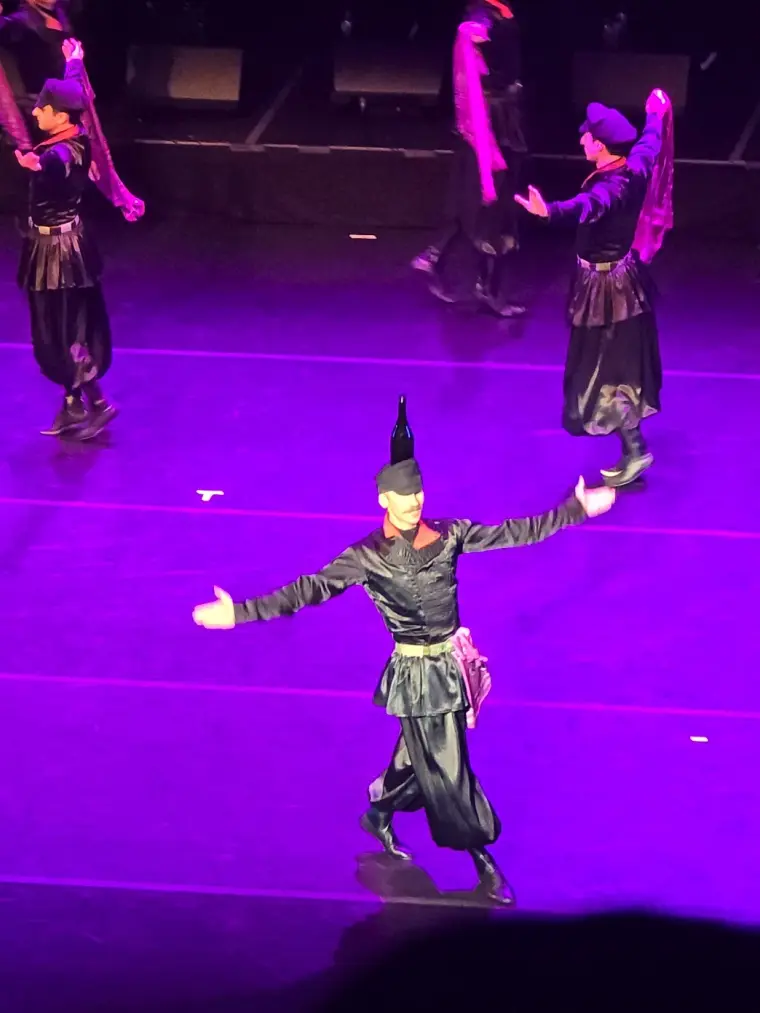 A wine bottle, balanced, hands free
What the Room Did
The Harris seats 1,499 and is a concrete box built under Millennium Park, which is usually a complaint and on Tuesday was not. The drums had somewhere to go. A hall with more plaster and more cloth would have softened the attack on the doli, and the whole argument of this music is attack — the gap between one strike and the next is where the dancers live. The boots on an unforgiving floor came through as part of the percussion rather than as noise over it, which is the correct accident.
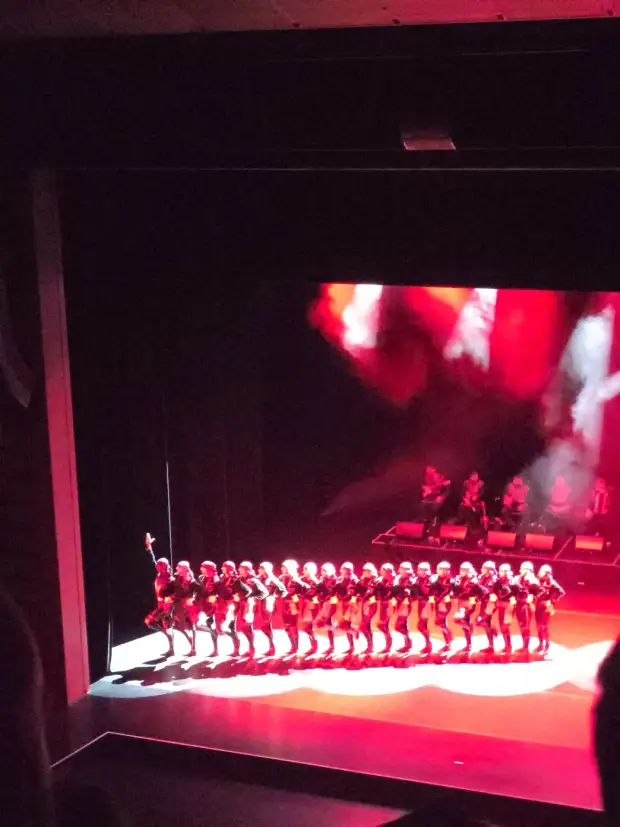 The line, bent in unison
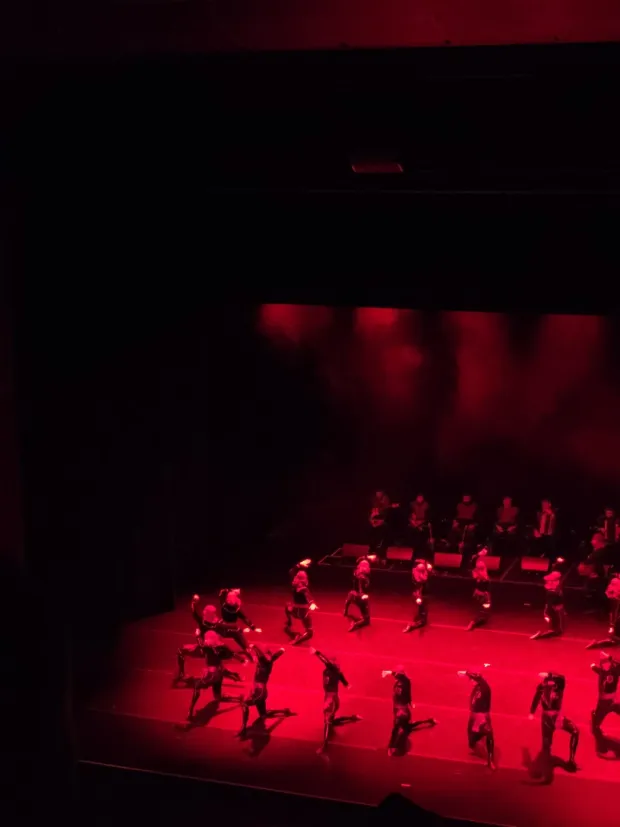 Low, and getting lower
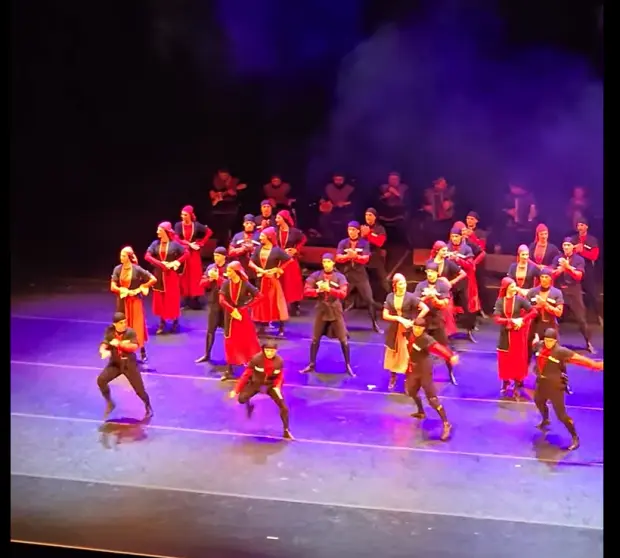 Red into blue
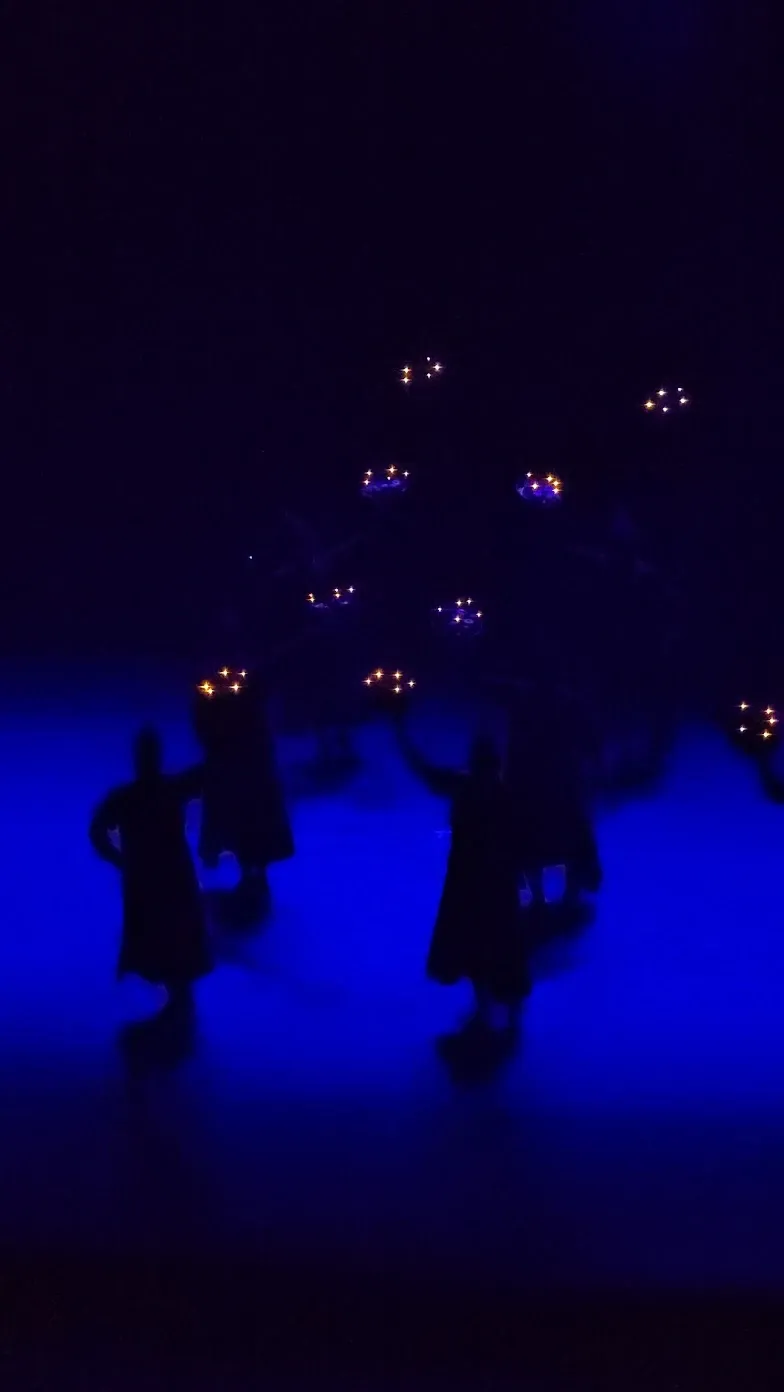
The strangest and best-looking thing in the programme is Karachokheli, which takes the stage to black and brings the corps on carrying small wreaths of light. For a minute or so the only visible objects in a 1,499-seat theatre are about a dozen clusters of warm points moving at head height, with a soloist surfacing out of the dark and going back into it. No projection, no haze gag, nothing plugged into a board. Somebody worked out a long time ago that an audience will hold its breath for a light it cannot explain.
This is also a tour that travels with its audience. The posts that went up overnight were in Russian, Spanish, Bulgarian and Georgian before they were in English — a Ukrainian woman in Chicago who wrote that she had wanted to see this company her whole life and had spent that same day on immigration paperwork, a group of thirteen women from two Bulgarian folk-dance ensembles who came together, a man who decided the company was a spectacle no Christian should miss. Nobody needed the programme note. They came because they already knew.
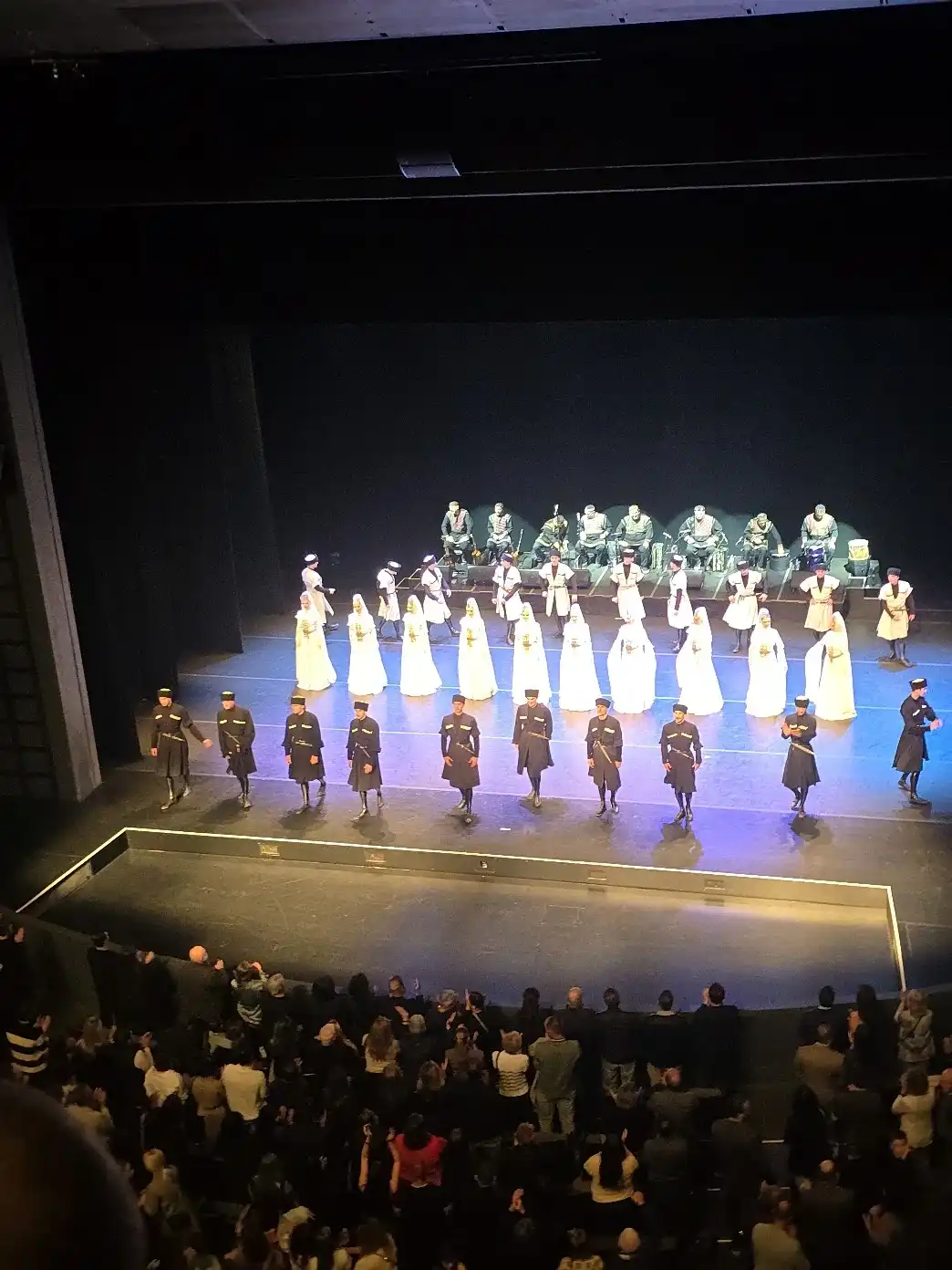
The house stood before the company had finished its first bow, which almost never happens, and then would not stop. There were cries for an encore from the balcony, in more than one language, going on well past the point where the stage lights had come up to tell everybody it was over. Two hours of men landing on the tops of their feet and spinning across concrete on their knees, and not one of them was named on anything the theatre handed out. A city that mostly does not know this company gave it everything it had.
Cover image: Sukhishvili, Harris Theater, October 20, 2026. Photo: Color&Noise