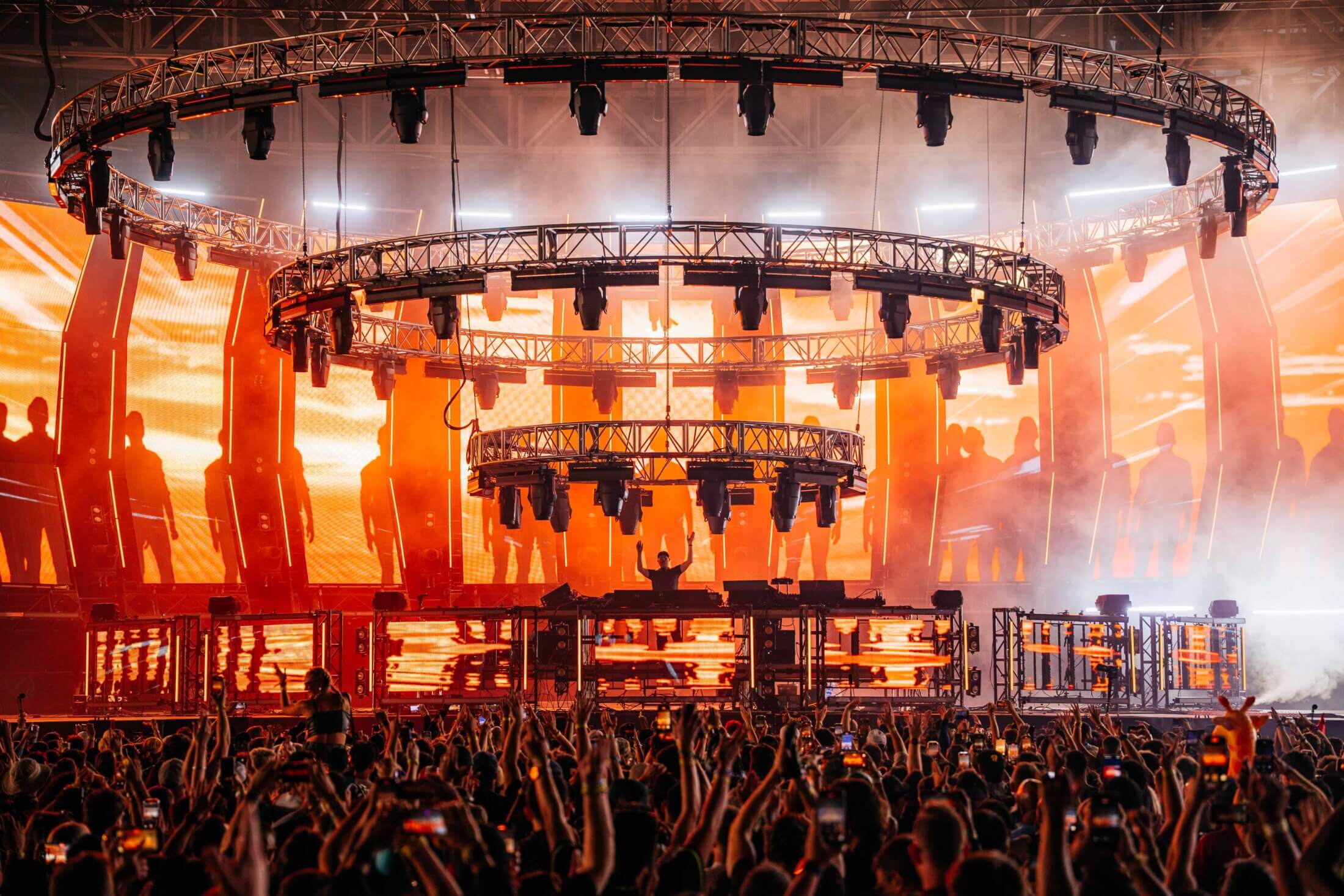
ARC Music Festival ran four days for the first time this year, September 4 through 7, more than 100 artists across four stages in Union Park. The fourth stage, The Midway, joined Grid, Area 909 and Expansions. Anyma, Underworld and Michael Bibi headlined, with Sara Landry presenting her ETERNALISM concept and Mau P, Mochakk and Chase & Status filling the card.
The names that matter most are Honey Dijon and Derrick Carter. Chicago invented house music and has spent forty years being thanked for it in the third paragraph, usually with an afternoon heritage slot and a crowd that shows up later for the touring headliner. Billing Dijon and Carter against Anyma is a statement about where authority in this music actually sits.
Whether that reads as a handoff or an uneasy coexistence depends on what Anyma’s audience came for. An Anyma set is a visual production with music attached. A Derrick Carter set is a man and a room. Putting them under one banner is either the most interesting thing ARC does or the contradiction at its center, and the festival seems comfortable either way.
The Park Is 13 Acres
The expansion is where 2026 got instructive. Everyone who liked the music agreed about what broke. Sound bleed was the defining failure: artists on the new Midway stage were drowned out by the Grid. Doors opened almost an hour late on Friday. Premium-pass lines ran down the block. Night one hit record-high temperatures.
Union Park is roughly 13 acres. Four stages of amplified dance music do not fit inside 13 acres without one of them losing, and the one that lost was the new one — which is to say the reason for the expansion. Strong crowd, real communal release, lessons learned. That last phrase is doing a lot of work.
The Union Park Inheritance
The other fact worth sitting with is the lot itself. Union Park is where Pitchfork Music Festival ran for 19 years before its parent company shut it down. That ground is now a ticketed electronic festival charging up to $549 on Labor Day weekend.
That is not an indictment of ARC, which did not kill Pitchfork and has built something with a genuine local argument behind it. It is a change in what the West Side’s festival park is for, and it arrives in the same summer that Douglass Park residents started saying out loud that Chicago has outgrown lending public parks to private festivals. ARC is the best possible version of the thing those residents are objecting to, which makes it the hardest case rather than an exception.
It also ran head-to-head with North Coast out in Bridgeview on the identical holiday weekend, which is a lot of dance music for one metro to absorb at once. Union Park’s own festival history is catalogued on Commons.
Four days is a long ask. The case for it is that Chicago house waited since the mid-eighties for a festival treating it as the headline rather than the credential. The case against is that the fourth stage could not be heard over the first.
Cover image: Via arcmusicfestival.com