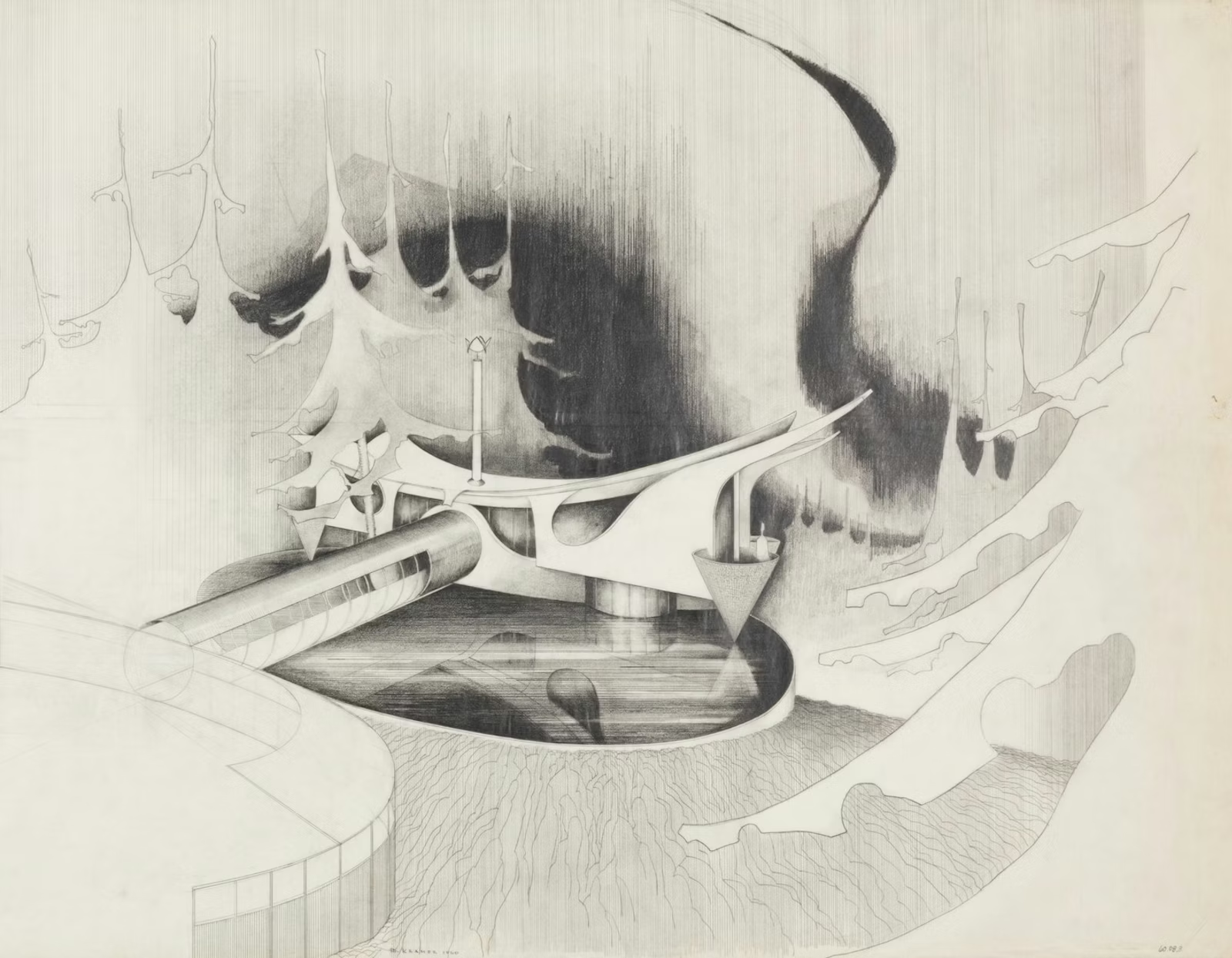
One must occasionally retreat from the curated minimalism of the modern wing to remember that architecture is allowed to be a riot. The Art Institute has finally unearthed the archives of Bruce Goff for Material Worlds, the first major retrospective of the Oklahoma architect in three decades. It is a necessary, if somewhat chaotic, reminder that "good taste" is often just a lack of imagination.
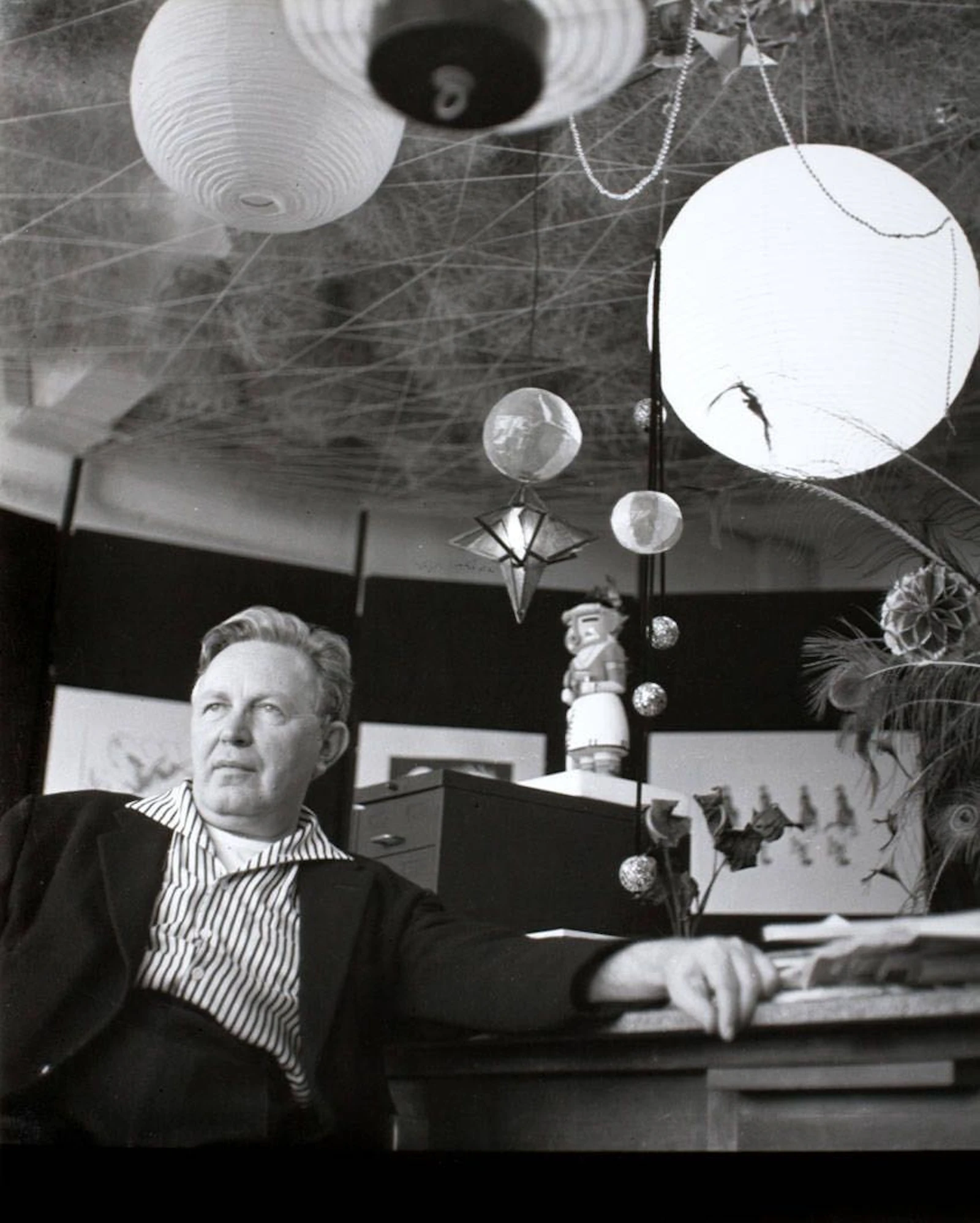
Bruce Goff in his office at the University of Oklahoma, about 1954
Philip B. Welch
Goff was a man who looked at the mid-century’s glass boxes and decided they were essentially coffins. In the Regenstein Hall, curators Alison Fisher and Craig Lee have assembled over 200 works that argue for a modernism that is tactile, queer, and unrepentantly plural. While his mentor Frank Lloyd Wright sought a dignified unity with nature, Goff sought a collision. He built with coal, goose feathers, glass cullet, and sequins. He used Quonset hut ribs to create mushroom-shaped domes and turned military surplus into domestic cathedrals.
The exhibition design by New Affiliates avoids the sterile neutrality of a standard retrospective. Instead, it mirrors Goff’s own refusal of boundaries. Architectural drawings that verge on the hallucinatory are placed alongside his personal collections of seashells, crystals, and Japanese embroidery. There is even a player piano performing his own musical compositions—hand-punched rolls that treat sound as a spatial geometry. It is a portrait of a mind that viewed science fiction, Navajo art, and 1940s pulp magazines with the same intellectual rigor.
One cannot walk through this "riotous material world" without feeling the weight of the professional price Goff paid for his eccentricity. He was pushed to the margins of the canon, labeled a purveyor of kitsch. Yet, standing before the models of the Bavinger House or the Ford House, one sees a radical independence that makes our current "image-driven" architecture look positively timid. Goff didn’t just build houses; he built planets.
If the sensory overload begins to weigh on you, I suggest finding the display of his abstract paintings on lenticular plastic. Stand perfectly still and watch the colors shift. It is a masterclass in how to weaponize light and texture, a reminder that in Goff’s world, the surface is never just a surface—it is a spatial argument.